Intentionally Design Your Life
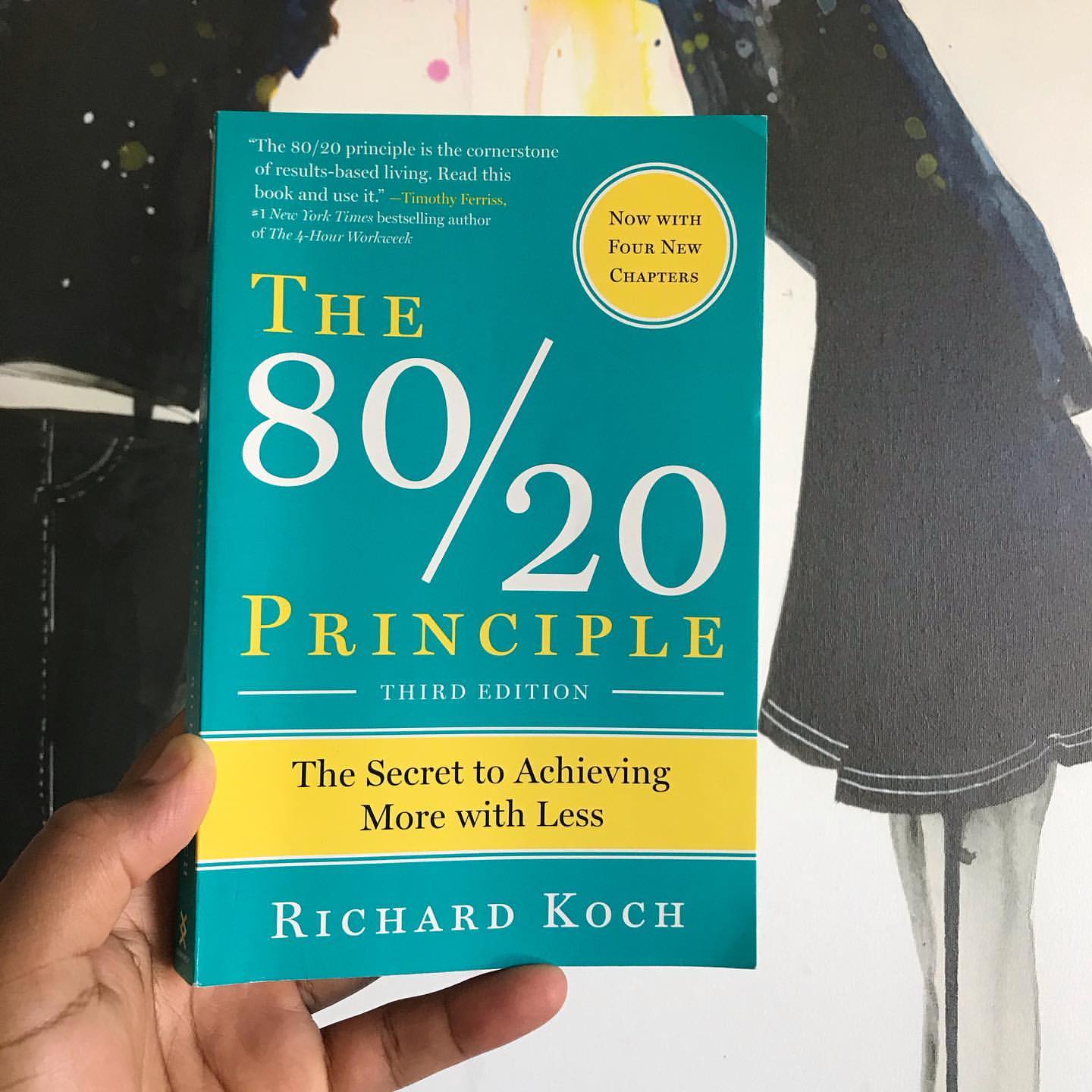
The 80/20 Principle, Richard Koch, Richard Koch
“The 80/20 Principle can raise personal effectiveness and happiness. It can multiply the profitability of corporations and the effectiveness of any organization. It even holds the key to raising the quality and quantity of public services while cutting their cost. It is one the best ways of dealing with and transcending the pressures of modern life.” ~ Richard Koch
This book might easily be one of my favorites! I found value in nearly every page, but I will try and distill critical points that I found relevant to serve you well.
Defining the 80/20 Principle: asserts that a minority of causes, inputs, or efforts usually lead to most of the results, outputs, or rewards. A typical pattern will show that 80 percent of outcomes result from 20 percent of inputs, 80 percent of consequences flow from 20 percent of causes, or 80 percent of results come from 20 percent of effort.
Why you should care about the 80/20 Principle:
Once we understand that a small portion of things is responsible for most of our results, we can achieve our desired outcomes with much less effort. The whole idea focuses on the essential 20 percent that delivers the results, discard the trivial matters, and enjoy our lives.
Koch tells us that the 80/20 turns conventional wisdom upside down. Here are a few ways to start implementing them in our lives; refer to chapter two, How To Think 80/20, for the entire list.
- celebrate exceptional productivity, rather than raise average efforts
- look for the shortcut, rather than the entire course
- exercise control over our lives with the least possible effort
- be selective, not exhaustive
- strive for excellence in few things, rather than good performance in many
- choose our careers and employers with extraordinary care, and if possible, employ others rather than being employed ourselves.
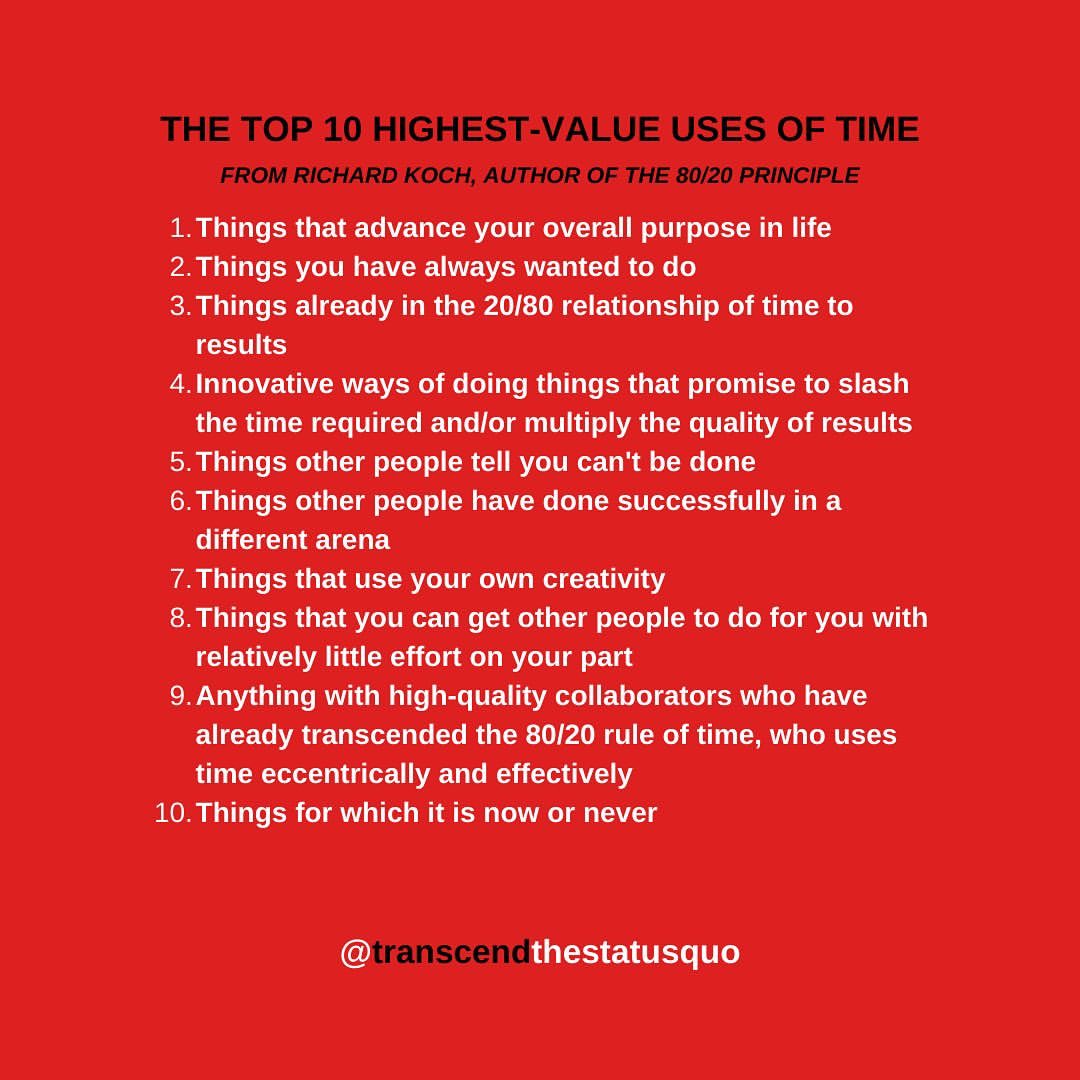
High-value uses of time:
Here are The Top 10 low-value uses of time:
Stop doing these things immediately
- Things that other people want you to do
- Things that have always been done this way
- Things you’re not unusually good at doing
- Things you don’t enjoy doing
- Things that are constantly interrupted
- Things few other people are interested in
- Things that have already taken twice as long as you initially expected
- Things where your collaborators are unreliable or low quality
- Things that have a predictable cycle
- Answering the telephone
How can you start eliminating these tasks from your daily life to make space for your most high-value uses of time?
High-value: start implementing these as soon as possible
- Things that advance your overall purpose in life
- Things you have always wanted to do
- Things already in the 20/80 relationship of time to results
- Innovative ways of doing things that promise to slash the time required and multiply the quality of results
- Things other people tell you can’t be done
- Things other people have done in a different arena
- Things that use your creativity
- Things that you can get other people to do for you with relatively little effort on your part
- Anything with high-quality collaborators who have already transcended the 80/20 rule of time, who use time eccentrically and effectively
- Things for which it is now or never
Can you identify ways to immediately implement some of these high-value criteria into your life this week?
Koch offers sage career advice, especially for those in the early stages of their career. He suggests carefully crafting up to six or seven rock-solid business alliances. These alliances should comprise one or two relationships with mentors (people more senior than you), two or three relationships with peers, and one or two relationships where you are the mentor.
Here are Koch’s Top Ten Golden Rules For Career Success:
1. Specialize in a small niche; develop a core skill
2. Choose a niche that you enjoy, where you can excel and stand a chance of becoming an acknowledged leader.
3. Realize that knowledge is potential power
4. Identify your market and your core customers and serve them well
5. Identify where 20 percent of effort gives 80 percent of returns
6. Learn from the best
7. Become self-employed early in your career
8. Employ as many net value creators as possible
9. Use outside contractors for everything but your core skill
10. Exploit capital leverage
Koch elaborates on each of these ten points, so when you read or listen to this book, please pay close attention to them in chapter thirteen, Intelligent and Lazy. The remaining chapters are on how to leverage the power of the 80/20 Principle concerning money, personal happiness, and our subconscious mind.
If you haven’t already, please read or listen to The 80/20 Principle, and share it with a friend. It truly is a remarkable piece of work and is worth frequently revisiting.
Here are five rules for decision making with the 80/20 Principle:
1.) Before deciding anything, picture yourself with two trays in front of you, one marked essential decisions and the other unimportant decisions. Don’t waste time, thoughts, or energy on trivial things. Be decisive.
2.) Most important decisions are often those made by default because you did not previously recognize turning points. To identify turning points, you have to gain perspective by examining threats for the potentially detrimental consequences.
3. Use The 80 / 20 / 100 Rule, which calls for gathering 80 percent of the data and performing 80 percent of the relevant analyses in the first 20 percent of the time available, then making a decision 100 percent of the time as if you were 100 percent confident that you made the right decision.
4. If what you have decided ends up not working, change your mind and make adjustments sooner rather than later.
5. When something is working well, double down.